
NTC temperature control is an important part of modern flexible heating systems. Instead of simply supplying constant electrical power to a heating element, an NTC-based control system can monitor temperature and adjust heating according to real-time feedback.
For flexible heating products such as heated eye masks, heating pads, blankets, wearable heaters and wellness products, this type of temperature feedback can help create more stable and controlled heating behavior.
But how does an NTC sensor actually work? What does closed-loop temperature control mean? And what should OEM and ODM buyers consider when developing a smart heating product?
This guide explains the fundamentals.
What Is an NTC Temperature Sensor?
NTC stands for Negative Temperature Coefficient.
An NTC thermistor is a temperature-sensitive resistor whose electrical resistance decreases as temperature increases.
This resistance-temperature relationship allows an electronic control system to estimate temperature by measuring the resistance of the thermistor.
NTC thermistors are widely used as temperature sensors because they provide high temperature sensitivity in a compact and relatively simple component.
TDK describes NTC thermistors as semiconductor resistors whose resistance decreases as temperature rises, with their high sensitivity making them widely used for temperature measurement and thermal management.
This basic principle makes NTC sensors suitable for integration into flexible heating products.
How Does NTC Temperature Control Work?
An NTC-controlled heating system normally contains several important components:
- a heating element;
- an NTC temperature sensor;
- a controller or microcontroller;
- a power-control circuit;
- software or control logic;
- electrical protection components.
The sensor continuously provides temperature-related information to the controller.
The controller then compares the measured temperature with the desired target temperature.
If the temperature is below the target, the system can supply more power to the heater.
When the temperature approaches or exceeds the target, the controller can reduce or interrupt power.
This process creates a feedback loop.
What Is Closed-Loop Temperature Control?
Closed-loop control means that the heating system does not simply operate according to a fixed power level.
Instead, it continuously uses temperature feedback to determine what the heater should do next.
A simplified process looks like this:
Target temperature → Heating → NTC sensing → Temperature feedback → Controller adjustment → Heating adjustment
This cycle repeats during operation.
The goal is to keep the actual product temperature within an acceptable operating range around the desired setpoint.
This is different from an open-loop heater, where electrical power may be applied without direct feedback from the actual temperature of the heating area.
Why Is Closed-Loop Control Important?
Flexible heating products are affected by many external variables.
For example:
- ambient temperature;
- body contact;
- insulation;
- textile thickness;
- airflow;
- battery voltage;
- heater resistance;
- product placement.
A heater operating at the same electrical power does not necessarily remain at exactly the same surface temperature under all conditions.
That is why temperature feedback can be valuable.
Instead of assuming that a particular voltage always produces a particular temperature, the system can respond to actual measured conditions.
How Does the NTC Sensor Measure Temperature?
The NTC sensor does not directly send a temperature number such as 45°C.
Instead, its electrical resistance changes with temperature.
The control circuit measures this resistance, or a related voltage, and converts the reading into an estimated temperature.
Vishay describes NTC temperature sensing using the relationship between resistance and temperature, commonly expressed as R = f(T).
The controller can use:
- a resistance-temperature table;
- a Beta-value equation;
- the Steinhart-Hart equation;
- calibrated lookup data;
to calculate the corresponding temperature.
The accuracy of the final result depends on more than the thermistor alone.
What Determines NTC Temperature Accuracy?
This is especially important for OEM buyers.
An NTC sensor does not automatically guarantee ±1°C product temperature control.
Several factors affect accuracy.
NTC Thermistor Tolerance
Different thermistors have different resistance and B-value tolerances.
These tolerances create measurement uncertainty.
Reference Resistor Accuracy
The resistor used with the NTC in the measurement circuit also has a tolerance.
That tolerance affects calculated temperature.
ADC Resolution
When a controller converts the analog sensor signal into digital data, the resolution and quality of the analog-to-digital converter affect measurement precision.
Sensor Calibration
Calibration can improve the accuracy of a temperature measurement system.
TDK notes that circuit design, calibration, self-heating, signal amplification and other hardware factors need to be considered when converting NTC resistance into a digital temperature reading.
Sensor Placement
Where the NTC sensor is placed can be just as important as the sensor specification.
If the sensor is located far from the hottest area, its reading may not represent the maximum product temperature.
Why Sensor Placement Matters
Imagine a flexible heating pad.
The NTC sensor may be placed:
- directly on the heating film;
- between textile layers;
- near the user’s body-contact surface;
- near an electrode;
- near the center of the heating zone.
Each position may produce a different temperature reading.
The sensor should therefore be positioned according to what the control system is intended to monitor.
For example, monitoring the heater itself and monitoring the user-contact surface are not always the same engineering problem.
This is why thermal mapping is useful during product development.
NTC Control and CNT Heating Film
NTC temperature control works particularly well as part of a complete flexible heating system.
For example, a system using carbon nanotube heating film may combine:https://flextherm.tech/ntc-temperature-control-smart-heating/
CNT heating film → NTC sensing → controller → power regulation
The CNT heating element generates heat, while the NTC sensor provides temperature feedback.
The control electronics then determine whether more or less electrical power is needed.
This creates a complete heating system rather than simply a powered heating material.
For FlexTherm’s technology platform, this distinction is important.
The heating film, temperature sensor, controller, power supply and product structure should be engineered together.
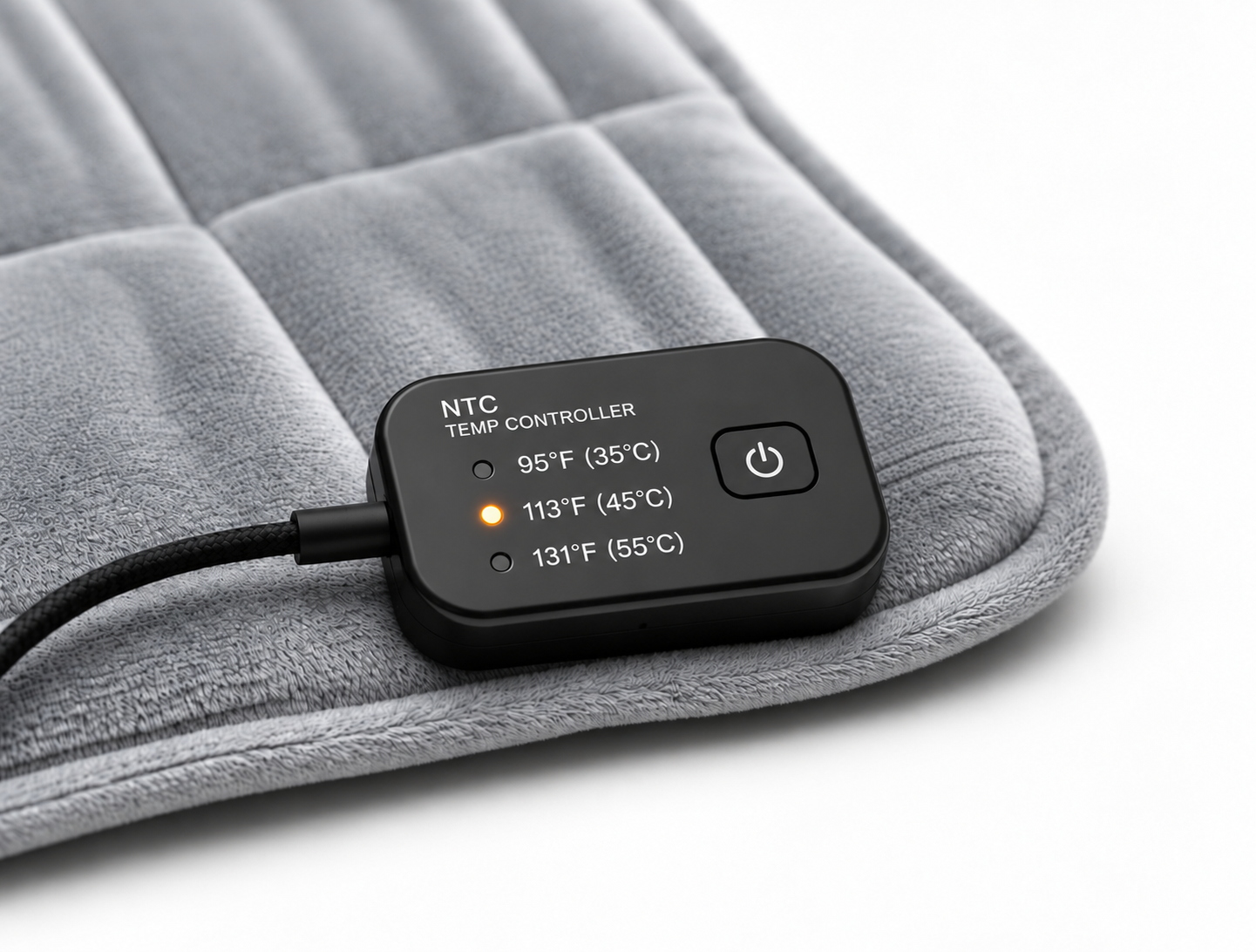
Fixed Temperature Levels
Many consumer heating products provide selectable temperature levels.
For example:
- Low
- Medium
- High
or specific settings such as:
- 35°C
- 45°C
- 55°C
These numbers should be treated as control targets or nominal settings unless testing demonstrates how closely the finished product maintains them under defined conditions.
The actual surface temperature can be influenced by product construction and environmental conditions.
For this reason, OEM specifications should clearly define:
- where temperature is measured;
- under what ambient conditions;
- after what heating duration;
- with what measurement equipment;
- and what tolerance is acceptable.
What Is Temperature Hysteresis?
A controller does not always switch on and off at exactly one temperature.
For example, if a target is 45°C, a simple controller might stop heating at one threshold and restart when the temperature falls below another threshold.
The difference between these thresholds is called hysteresis.
Hysteresis helps prevent the controller from rapidly switching power on and off around a single temperature point.
More advanced controllers may use proportional or PID-based control strategies instead of simple threshold switching.
The correct method depends on the product.
What Is PID Temperature Control?
PID stands for:
- Proportional;
- Integral;
- Derivative.
A PID controller continuously considers the difference between the measured temperature and the target temperature.
Instead of simply switching heating fully on or off, it can adjust output more gradually.
In some systems, this can reduce overshoot and improve temperature stability.
However, PID control is not automatically necessary for every heating product.
A simpler control strategy may be entirely appropriate depending on thermal response, cost, electrical design and product requirements.
Temperature Control vs. Temperature Protection
These two concepts should not be confused.
Temperature control manages the normal operating temperature.
Temperature protection is intended to respond to abnormal conditions.
A well-designed heating system may use several layers of protection.
Depending on the product, these can include:
- software temperature limits;
- NTC fault detection;
- over-temperature protection;
- thermal fuses;
- current protection;
- timer functions;
- automatic shut-off.
The exact safety architecture depends on the product category and applicable requirements.
What Happens If the NTC Sensor Fails?
A smart controller should consider abnormal sensor conditions.
For example, the system may detect:
- an open circuit;
- a short circuit;
- an implausible temperature reading;
- an abnormal resistance value.
The controller can then enter a safe state instead of continuing normal heating.
This type of fault handling should be considered during product development.
What About Automatic Shut-Off?
Automatic shut-off can be implemented separately from temperature regulation.
For example, a product may automatically stop heating after:
- 30 minutes;
- 60 minutes;
- 90 minutes;
- a customized operating period.
This can be useful for products such as eye masks, heating pads and wellness devices.
However, automatic shut-off is a controller feature, not an inherent property of an NTC sensor.
The product’s timer, firmware and electrical architecture determine whether this function is available.
Can NTC Systems Control Multiple Heating Zones?
Yes, but only if the system is designed for it.
A multi-zone heating system may have:
- multiple heating elements;
- multiple NTC sensors;
- separate control channels;
- independent target temperatures.
For example, one area of a wearable heating product may require more heat than another.
A properly designed multi-zone system can control these areas separately.
But simply using one NTC thermistor does not make a product multi-zone.
Why Thermal Imaging Is Important
An NTC sensor only measures temperature at or near its installed location.
It cannot show the complete temperature distribution across a heating product.
That is why infrared thermal imaging can be useful during development.
Thermal imaging can help engineers identify:
- heating uniformity;
- hot spots;
- cold areas;
- edge effects;
- electrode heating;
- response time.
Combining NTC sensor data with thermal imaging gives a more complete picture of system performance.
Applications of NTC Smart Temperature Control
NTC temperature sensing can be integrated into many flexible heating products.
Heated Eye Masks
Temperature feedback can help manage heating close to the user’s face.
Flexible Heating Pads
Heating pads for the waist, neck, shoulders or back can use controlled temperature levels.
Heated Blankets
Sensors and controllers can help regulate heating during longer operating periods.
Wearable Heating Products
Heating vests, knee products, gloves and insoles can use compact temperature-control systems.
Pet Heating Products
Controlled heating can be particularly important where a pet may remain in contact with a warm surface for extended periods.
Wellness and Therapy Products
Heating functions can also be combined with massage or compression systems.
What Should OEM Buyers Specify?
When developing a custom heating product, buyers should not simply ask:
“Does it have NTC control?”
A better specification includes:
Target Temperature
What temperature should the product reach?
Temperature Tolerance
How much variation is acceptable?
Measurement Point
Where should temperature be measured?
Heating Time
How quickly should the product reach its operating range?
Power Source
Will the product use USB, a battery, an adapter or another supply?
Heating Zones
Does the product require one heating area or several independently controlled zones?
Automatic Shut-Off
Should the system stop after a defined operating period?
Fault Protection
What should happen if the sensor or heater behaves abnormally?
These requirements should be defined before the heating system is finalized.
NTC Smart Control for OEM and ODM Heating Products
A reliable heating product requires more than adding an NTC sensor to a heating element.
The complete system needs coordinated development.
This can include:
- heating element design;
- sensor selection;
- sensor placement;
- controller development;
- temperature profiles;
- power configuration;
- protective functions;
- product materials;
- prototype testing;
- thermal imaging;
- mass-production validation.
FlexTherm integrates CNT flexible heating technology and smart temperature control into customized OEM and ODM heating products.
The goal is to design the heating system around the requirements of the finished product rather than treating the controller as a separate accessory.
Frequently Asked Questions
What does NTC mean?
NTC means Negative Temperature Coefficient. An NTC thermistor decreases in resistance as its temperature increases.
Does an NTC sensor control temperature by itself?
No. The NTC sensor measures temperature-related resistance. A controller, power circuit and control logic are required to regulate heating.
Can NTC temperature control maintain exactly ±1°C?
It depends on the entire system. Sensor tolerance, circuit design, calibration, sensor placement, control algorithm and product thermal characteristics all affect accuracy.
Can one NTC sensor control multiple heating zones?
A multi-zone product normally requires appropriately designed sensors, heating zones and control channels.
Can NTC control be used with CNT heating film?
Yes. An NTC sensor can provide temperature feedback for a CNT flexible heating system when the complete electrical and thermal system is designed accordingly.
Conclusion
NTC temperature control provides an effective way to add real-time temperature feedback to flexible heating systems.
The thermistor senses temperature changes, the controller interprets the signal, and the heating system adjusts electrical power according to the target temperature.
But reliable temperature control depends on the entire system.
Sensor accuracy, sensor placement, heating-element design, electronics, control logic and finished-product construction all influence the final result.
For OEM and ODM heating products, the best approach is therefore to develop the heating element and temperature-control system together.